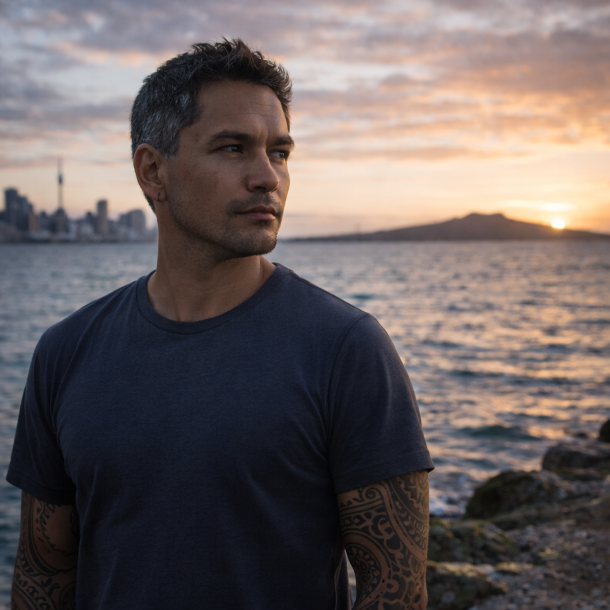
Commander Ariki Te Rangi
Name Ariki Te Rangi
Position Commanding Officer
Rank Commander
Character Information
| Gender | Male | |
| Species | Human | |
| Age | 39 |
Physical Appearance
| Height | 6’0” (183 cm) | |
| Weight | 192 lbs (87 kg) | |
| Hair Color | Dark brown, nearly black | |
| Eye Color | Dark Brown | |
| Physical Description |
Family
| Spouse | Emily Harper is a civilian xenobiologist whom Ariki met during a joint frontier research assignment early in his command track. Their relationship developed quickly, rooted in mutual respect and a shared belief in service beyond self. They married during his posting aboard the USS Hecate and later had two children together. Extended deployments and the demands of crisis command gradually created distance between them. The evacuation of Deep Space Relay Station Kōtare became the turning point — not because of disagreement over his decision, but because it underscored a truth they had long avoided: Starfleet would always claim the greater share of his time. Their divorce was amicable but painful, grounded more in emotional absence than conflict. They maintain respectful communication, particularly regarding their children, though the separation remains a quiet weight Ariki carries. |
|
| Children | Aiden is the elder of Ariki’s two children, thoughtful and observant like his father but more openly expressive. He has inherited a strong curiosity about space and often asks detailed questions about starships and distant systems. Though he lives primarily with his mother, Ariki makes deliberate efforts to remain present in his life, scheduling regular long-distance calls and visits when possible. Mila Te Rangi (born 2398) Mila is energetic and fiercely independent, with a sharp sense of humour that mirrors Ariki’s own. She shares a strong connection with her grandmother and is particularly engaged in cultural traditions and language. Ariki is determined that both children remain deeply connected to their whakapapa, regardless of distance. |
|
| Father | Wiremu Te Rangi is a former maritime service officer who later worked in coastal infrastructure management in Auckland. A quiet and disciplined man, he raised Ariki with a strong sense of responsibility, cultural identity, and the belief that leadership is demonstrated through action rather than words. |
|
| Mother | Moana Te Rangi is an educator and cultural advisor based in Auckland, specialising in the preservation and teaching of te reo Māori and oral history. Warm but firm in her expectations, she ensured Ariki’s connection to his heritage remained active and lived, instilling in him a deep respect for whakapapa, community, and the quiet strength found in cultural continuity. |
|
| Brother(s) | Ariki’s younger brother, Hemi, remained in Aotearoa and works in environmental systems engineering, specialising in coastal resilience and marine sustainability. Practical and quietly stubborn, he shares his father’s steadiness but challenges Ariki more openly. The two maintain a close relationship, grounded in mutual respect and blunt honesty. Hemi often serves as an anchor to home, reminding Ariki of who he is beyond the uniform. |
|
| Sister(s) | The youngest of the three, Ana pursued a career in cultural preservation and community leadership, working closely with iwi organisations across Earth. Warm but perceptive, she sees through Ariki’s humour quickly and is often the only one who will press him when he retreats into silence. She maintains a particularly strong bond with Ariki’s children and ensures they remain closely connected to their heritage. |
Personality & Traits
| General Overview | Raised with a strong connection to his Māori heritage, Ariki carries a deep sense of guardianship and collective responsibility into his command philosophy. Loyalty is not transactional to him; it is foundational. He believes a captain’s first duty is to their people, and he will accept personal risk without hesitation if it ensures their safety. Despite his outward calm, Ariki has a tendency to internalise strain. He rarely speaks openly about his own burdens, preferring to absorb pressure rather than distribute it. His humour often serves as both shield and stabiliser — a way to steady those around him while keeping his own doubts contained. He is not reckless, nor is he cautious to the point of paralysis. He trusts instinct as much as analysis and is willing to make unconventional calls when circumstances demand it. Above all, he is defined by endurance. When others might retreat, Ariki remains — steady, present, and resolute. |
|
| Strengths & Weaknesses | However, those same qualities can become liabilities. Ariki has a tendency to internalise stress and emotional strain, rarely confiding in others when he is struggling. He absorbs pressure rather than sharing it, which can lead to isolation and fatigue over prolonged crises. His instinct to protect can also push him toward personal risk, sometimes placing himself in harm’s way unnecessarily. While not reckless, he can be stubborn when he believes a course of action is morally right, even when political or strategic realities suggest compromise. Beneath the dry humour and steady exterior, he carries the weight of his past decisions more heavily than he allows others to see. |
|
| Ambitions | Professionally, he believes in exploration as a moral responsibility. The frontier should be approached with curiosity and respect, not conquest. While he does not seek legacy, he quietly hopes that when his service is complete, he will be remembered not for victories, but for having stood firm when others needed him to. |
|
| Hobbies & Interests | Ariki is also deeply connected to his Māori heritage. He practices traditional carving on a small scale, a meditative craft that demands patience and precision. He maintains fluency in te reo Māori and keeps a small collection of recorded waiata and oral histories in his personal database. Though not outwardly demonstrative, he observes cultural traditions privately and ensures his children remain connected to their whakapapa. He is not particularly drawn to formal social gatherings, but values small, familiar company. Shared meals, quiet conversation, and the occasional dry joke are more his preference than ceremony. Languages Federation Standard (native), Te Reo Māori (native fluency), Klingon (conversational), Romulan (basic). |
| Personal History | Much of Ariki’s childhood was spent near the coast. The ocean became both constant and teacher — vast, patient, and indifferent to ego. That sense of horizon and distance would later mirror his comfort with deep space. Even as a young man, he gravitated toward responsibility rather than attention. Teachers noted steadiness over brilliance; he was not loud, but he was reliable. He entered Starfleet Academy in 2384, choosing the Tactical and Security track. The decision surprised few who knew him. Ariki was not drawn to the glamour of command or the prestige of science postings. He was drawn to protection — to standing between danger and others. He graduated in 2388 with honours in Tactical Operations, his instructors citing composure under stress as his defining trait. His early career aboard the USS Wellington and later the USS Venture exposed him to frontier volatility and post-Borg instability. These assignments hardened him, but did not change him. He developed a reputation for measured action — never the first to panic, rarely the last to stand. It was during his posting as Chief Security/Tactical Officer aboard the USS Hecate that he began to demonstrate the instinctive command presence that would define him. In 2398, Ariki was promoted to Commander and assigned as Executive Officer of Deep Space Relay Station Kōtare, a modest but strategically vital communications and logistics hub near the Beta Quadrant rim. The posting was meant to broaden his command exposure. Instead, it reshaped his life. In 2400, a catastrophic subspace destabilisation event — later determined to have been exacerbated by hostile interference — crippled the station. Systems failed in a cascading sequence. Command staff were incapacitated. With civilian families still aboard, evacuation protocols became chaotic and incomplete. Ariki assumed operational command. He rerouted power manually. Coordinated shield rotations under failing grid alignment. Ordered priority transports while sections of the station lost atmospheric integrity. For hours, he managed a controlled retreat under conditions that should have resulted in total loss of life. He remained aboard until the final civilian transport cleared docking control. The station did not survive. Over ninety percent of the civilian population did. Among Starfleet personnel, a quiet callsign followed him from that day forward: “Last Out.” He never encouraged it. He never denied it. The event marked him professionally — and personally. At the time of the Kōtare evacuation, Ariki was married with two young children. Extended deployments had already strained the marriage. His decision to remain aboard until the final transport, though tactically and morally consistent with his values, reinforced the reality that Starfleet would always demand more than home could give. The marriage ended within a year. The separation was not hostile, but it was final. He remained devoted to his children, determined that distance would not sever connection. He ensured they remained anchored to their whakapapa and cultural identity, even as his own life became increasingly tied to deep-space assignments. Following Kōtare, he served as Executive Officer aboard the USS Gallant, where his steady command presence drew the attention of senior leadership. When Starfleet commissioned the first of a new exploratory class — the USS Horizon — Ariki Te Rangi was selected to oversee her initial operational evaluation. He was trusted. Respected. Considered dependable under extreme conditions. He accepted the assignment without ceremony. By 2405, at thirty-nine years old, Ariki stood at the helm of Horizon as her provisional commanding officer. He did not seek legend, nor did he believe in destiny. He believed in duty. In people. In standing firm when others could not. He could not know that the next frontier would not test his resolve. It would redefine it. |
|
| Service Record | Starfleet Academy – Tactical & Security Track Graduated with honours in Tactical Operations and Crisis Command Theory. Recognised for field simulation performance and team-lead resilience under stress scenarios. 2388–2391 Security Officer – USS Wellington (Akira-class) Assigned to deep-space patrol and anti-piracy operations along the former Romulan Neutral Zone. Earned early commendations for boarding operation leadership and calm command during multi-vector engagement drills. 2391–2394 Assistant Chief of Security/Tactical – USS Venture (Sovereign-class) Transferred to a front-line exploratory cruiser. Participated in high-risk anomaly investigations and post-Borg destabilisation containment missions. Demonstrated aptitude for tactical adaptation in unpredictable environments. 2394–2398 Chief Security/Tactical Officer – USS Hecate (Steamrunner-class) Assigned to rapid-response deployment fleet. Led tactical and security coordination during frontier unrest and pirate suppression campaigns. Earned reputation for measured command presence and protective leadership style. 2398–2401 Commander – Executive Officer, Deep Space Relay Station Kōtare Promoted to Commander and assigned as XO to a frontier communications and logistics platform near the Beta Quadrant rim. During a catastrophic subspace destabilisation event compounded by hostile interference, Te Rangi assumed operational command after senior officers were incapacitated. Coordinated a full civilian evacuation under sustained systems failure and hostile pressure. Remained aboard until final transport departure. The station was lost. Civilian survival rate exceeded 92%. Unofficial callsign among personnel: “Last Out.” 2401–2404 Commander – Executive Officer, USS Gallant (Inquiry-class) Selected for starship XO posting following performance at Relay Station Kōtare. Oversaw tactical readiness and crew integration. Frequently assigned to lead external crisis response missions. 2404–2405 Provisional Commanding Officer – USS Horizon (Horizon Mk II-class) Hand-selected to lead the trial and operational evaluation of Starfleet’s newest long-range exploratory platform. Assigned to deep rim anomaly mapping and frontier reconnaissance missions. |